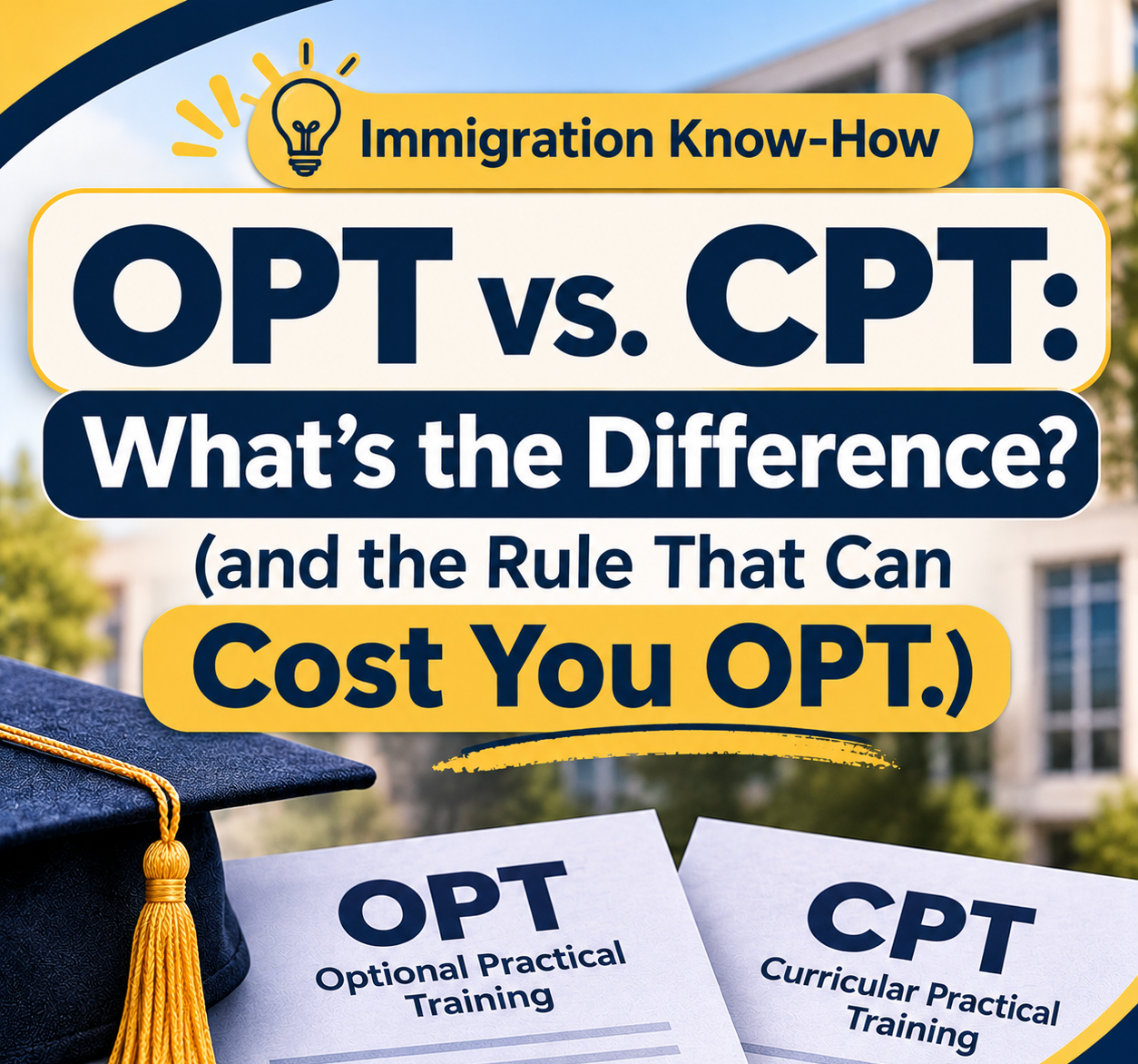
If you're on an F-1 visa, you've probably heard "CPT" and "OPT" used like they're the same thing, or interchangeably. They're not the same... and mixing them up can cost you a lot of time later.
What is CPT?
Curricular Practical Training (CPT) is work that's part of your program itself, like an internship, a co-op, or an alternative work-study arrangement tied to your degree. Your school's Designated School Official (DSO) authorizes CPT in SEVIS and gives you an updated I-20. You don't file anything with USCIS, and you don't get an EAD card for it. CPT can be part-time or full-time.
Who Can Use CPT, and When?
In general, you need to be enrolled full-time for one full academic year first. There's an exception for graduate programs that require you to start CPT right away. You can't start until your DSO has authorized it for a specific employer and dates.
What is OPT?
Optional Practical Training (OPT) is training directly related to your field of study, and it's authorized by USCIS, not just your school. You get up to 12 months of OPT at each degree level. You can use some of it during your program (pre-completion, limited to 20 hours a week while school is in session) or after you finish (post-completion). Students in eligible STEM fields can apply for a 24-month STEM OPT extension on top of that.
Timing Issues
For post-completion OPT, you file Form I-765 no earlier than 90 days before your program end date and no later than 60 days after it. You also have to file within 30 days of your DSO entering the OPT recommendation in SEVIS. You cannot start working until the start date on your EAD card.
On post-completion OPT, you can have no more than 90 days of unemployment in total; with a STEM extension an additional 60 days is added, so the total is 150 days across the whole OPT period.
The Rule That Can Cost You OPT
This is important for every student depending on OPT to know: if you use 12 months or more of full-time CPT, you lose eligibility for post-completion OPT at that same degree level. Part-time CPT doesn't count toward that.
So if you're stacking full-time internships, be sure that you are aware of how many months you are using before you say yes.
Finally, using CPT or OPT time does not block a future H-1B.
What's Happening With CPT Right Now?
In August, SEVP issued two broadcast messages that read the CPT rules much more narrowly, essentially saying the training had to be required for every student in the degree, not just tied to your program. On November 17th, a federal court in Massachusetts paused those broadcasts while the case continues. It's a temporary ruling, and the government could appeal.
Keeping Your Dates Straight
Between program end dates, I-765 filing windows, EAD start dates and unemployment days, F-1 life is a lot of dates, and that follows you as you move into an employment based status. Connect by InHouse Core keeps your family's immigration dates in one place and tells you when news that touches your status breaks, so you're not piecing it together from screenshots.
Connect is currently offering a free Consultation with a Green & Spiegel Immigration Attorney with a subscription. Learn more here: inhousecore.com/first-20
TLDR
CPT is part of your curriculum, approved by your DSO, no USCIS application is required.
OPT is approved by USCIS, up to 12 months per degree level, plus 24 more for eligible STEM fields.
File post-completion OPT between 90 days before and 60 days after your program ends, and within 30 days of your DSO's recommendation.
Twelve months or more of full-time CPT ends your post-completion OPT eligibility at that level, so count before you agree to additional internships/work. Be sure to communicate with your DSO every step of the way.
This post is for general information only and is not legal advice. For guidance on your specific situation, please consult a licensed immigration attorney or your school's DSO.