

CPT is Being Paused at Some Major Universities… Here's What's Really Happening
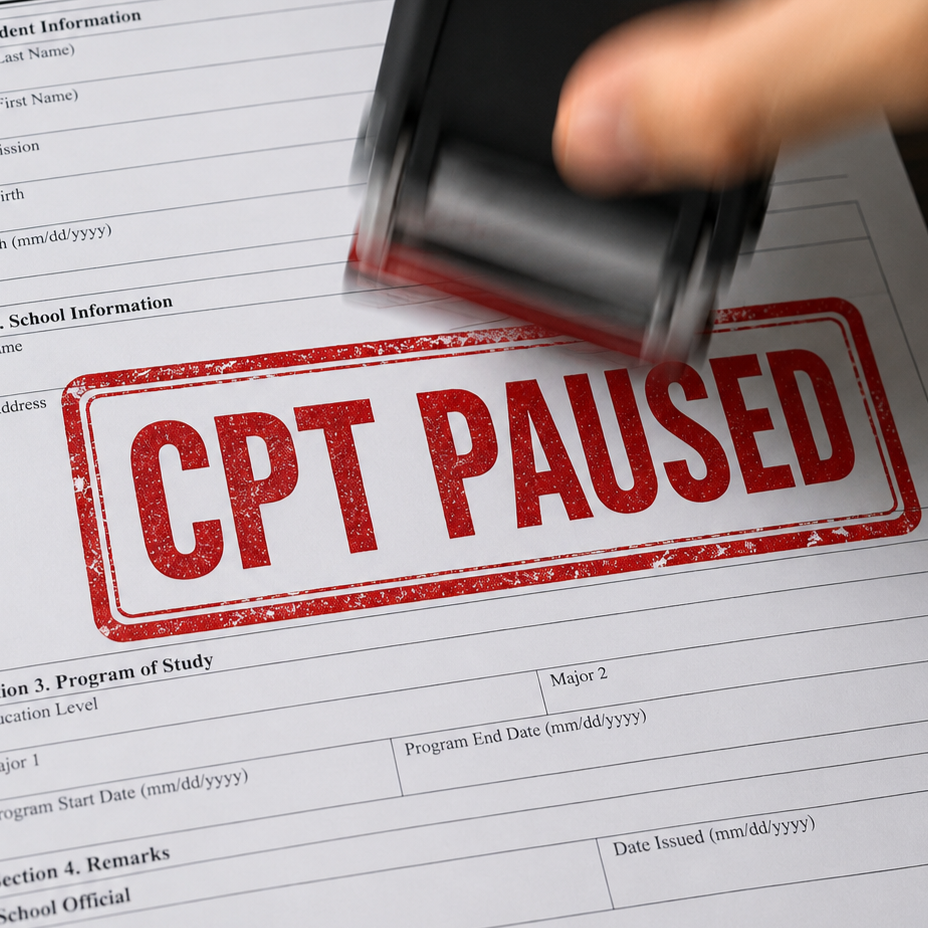
If you're an F-1 student and you've seen your school (or a friend's school) announce a pause on Curricular Practical Training (CPT) approvals, and you’re panicking… take a moment, it’s not as scary as the sensational media (or social media) are trying to make it seem.
What Changed
In August 2026, the Student and Exchange Visitor Program (SEVP), which sits under ICE, sent two memos to Designated School Officials (DSOs) at universities across the country. one on August 12th and a follow-up on August 24th.
The news makes it seem like there’s been some huge change, but the fac is that the underlying regulation didn't change. CPT has always required that the training be an "integral part of an established curriculum." What changed is enforcement; SEVP is now telling schools to apply a much stricter read of that standard, and warning DSOs they can be held personally liable if they authorize CPT that doesn't meet it.
That's what triggered the wave of caution across campuses… they need some time to recalibrate and to make sure they are following guidance appropriately.
Which Schools Are Affected
CPT is administered school-by-school, so the response has varied. Several major universities, including UC Berkeley, the University of Washington, USC, University of Illinois Urbana-Champaign, and UCLA, have publicly announced that they have paused or restricted new CPT approvals while they review the guidance, but every university that has a CPT program will choose how they will respond to these shifts. If you are concerned about your school’s program, you should reach out to your University’s DSO.
The Real Enforcement Shift: Mandatory vs. Elective CPT
As mentioned earlier, the actual rule hasn’t changed, just the level/interpretation of how it should be enforced. This is what’s really shifting:
Mandatory CPT: where an internship or practicum is an official graduation requirement for everyone in your program, listed in the course catalog . This type of CPT is not the target of this guidance. Processing for mandatory CPT should continue normally.
Elective CPT: where a student finds a job first, then registers for an optional course to attach credit and unlock work authorization… this is exactly what this guidance is aimed at, and where we are likely to see denials and pauses on new requests.
If you're not sure which category your CPT falls into, that's the first question to ask your DSO.
Were Already-Approved CPT Authorizations Revoked?
No. Multiple schools, including USC and the University of Wisconsin, have explicitly stated that Fall 2026 CPT authorizations approved before their pause took effect are not being retroactively rescinded. If your CPT was already approved, that approval is standing.
What You Should Do
Contact your University’s DSO if you have concerns. You can also speak with an experienced, qualified US Immigration attorney.
Don't make any changes to your employment without first seeking guidance, and do not ever work without explicit, current authorization.
If your internship is elective rather than a stated degree requirement, you should reach out to your DSO as soon as possible.
This is genuinely a "your school, your program, your situation" kind of issue. Your DSO is your first and best resource here.
One More Thing on the Horizon
Separately from CPT, there's a bigger regulatory change coming on September 15, 2026: the end of "Duration of Status" for F-1 and J-1 students, which will move students from open-ended status to a fixed admission period requiring more frequent renewals through USCIS. It's a different issue from the CPT guidance, but it's worth having on your radar if you're an international student planning ahead.
TLDR:
The CPT rule itself hasn't changed, enforcement has tightened.
Pauses are school-specific, not a nationwide ban.
Already-approved CPT is not being taken away.
Elective CPT is where the risk is; mandatory CPT is generally fine.
Talk to your DSO about your specific situation today.
This post is for general information only and is not legal advice. For guidance on your specific CPT or immigration status, please consult your school's DSO or a licensed immigration attorney.
