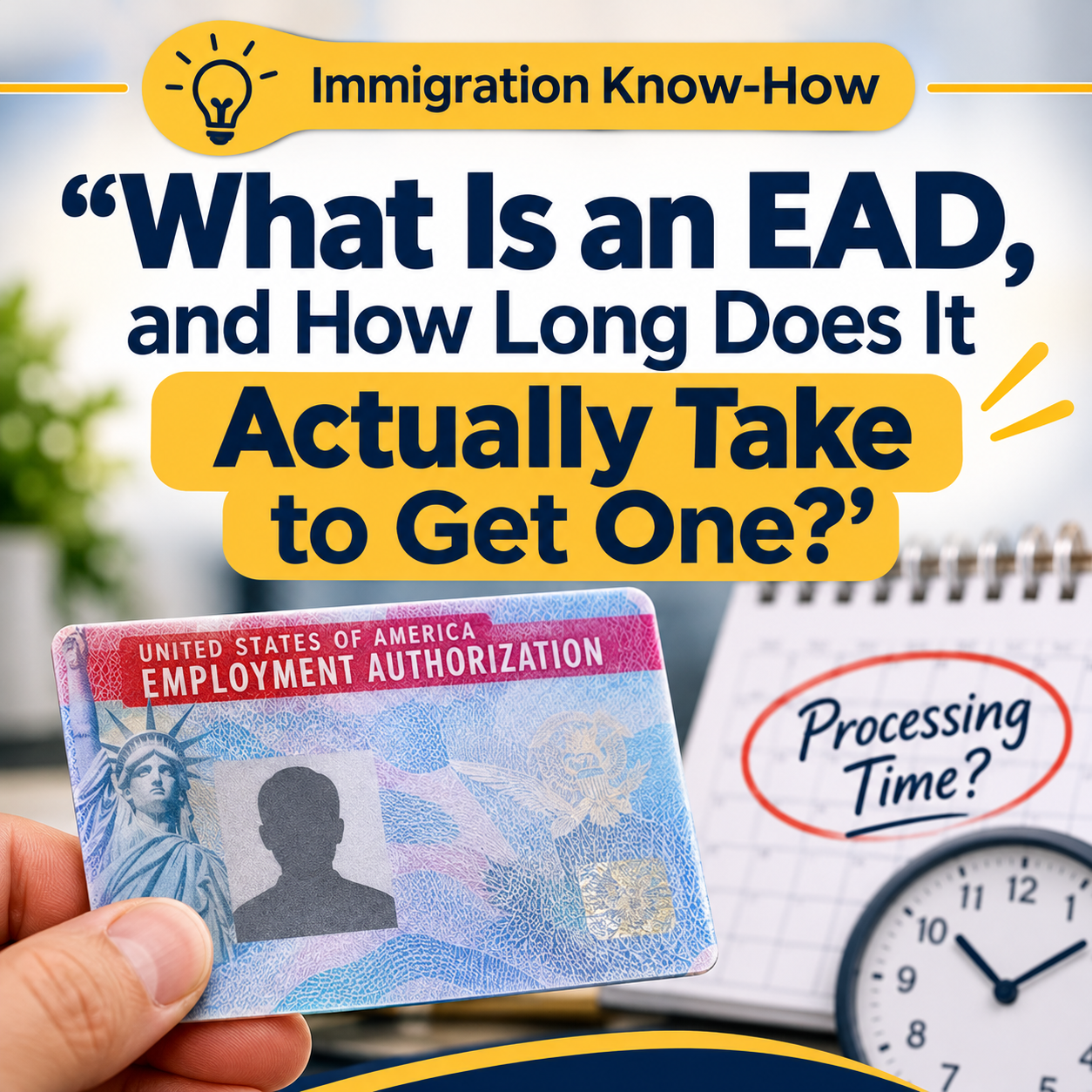
“EAD” is one of those terms everyone in your immigration tosses around... and nobody explains. Let's fix that.
What is an EAD?
EAD stands for Employment Authorization Document. It's the card USCIS issues after it approves Form I-765, the application for employment authorization, which gives people authorization to work (pretty obvious based on the name, huh?) Some people are allowed to work based on their status alone, like an H-1B worker, for example, is authorized to work for the sponsoring employer. Others need the card before they can start a job. That includes H-4 spouses who meet the H-4 EAD rules, F-1 students on OPT, and people with a pending green card application (I-485) who file for work authorization while they wait, among others.
Who doesn't need one
L-2 and E spouses are authorized to work incident to their status, so they don't depend on an EAD card the way H-4 spouses do. If you're not sure which group you're in, look at the category code on your card or on your I-765 receipt notice.
How long it takes to get one
There isn't a definitive, singular timeline for EAD processing, and anyone who gives you a single number for every case is guessing. Processing time depends on your category and the office handling it. The best place to check is the USCIS Processing Times tool: choose Form I-765, then your category, then your office. For H-4 spouses, one immigration law firm reported in September that a standalone H-4 EAD often takes 12 months or more, while one filed together with the H-4 extension has been taking roughly 6 to 9 months.
Changes to Renewal Timelines
For years, due to painful processing times, many people filing an EAD renewal on time got an automatic extension of up to 540 days, so they could keep working while USCIS caught up. That's gone for renewals filed on or after October 30, 2025. DHS finalized the rule on October 14, 2026, and it took effect the same day. It covers H-4 spouses (category c26), people with a pending green card application (c9), asylum applicants, refugees and asylees, and some TPS holders. Renewals filed before October 30, 2025 keep the old extension.
The STEM OPT 180-day extension comes from a different rule and isn't affected.
What that means from a practical standpoint: if your card expires before the new one arrives, you have to stop working until you receive it. That's why the renewal timeline is more critical now than it has been previously.
Keeping the whole family's dates in one place
This is exactly why I built Connect by InHouse Core. It tracks dates for the whole family, tagged to each person's status, so the H-4 spouse's timeline isn't buried under the H-1B paperwork.
You can see how it works on our family immigration tracker page, and if you want the bigger picture on dates, start with understanding priority dates and the important difference between your visa and status.
TLDR
An EAD is the work permit card USCIS issues after approving Form I-765.
H-4 spouses, F-1 students on OPT and green card applicants with a pending I-485 need one to work; L-2 and E spouses don't.
Processing time depends on your category and office, so check the USCIS Processing Times tool for I-765 and your category.
If you're an H-4 spouse or a pending green card applicant renewing your card, there's no automatic extension anymore for renewals filed on or after October 30, 2025, so plan your renewal months ahead and talk to your attorney about timing.
This post is for general information only and is not legal advice. For guidance on your specific situation, please consult a licensed immigration attorney.