

DHS Proposes Eliminating the 60-Day Grace Period for Several Temporary Workers
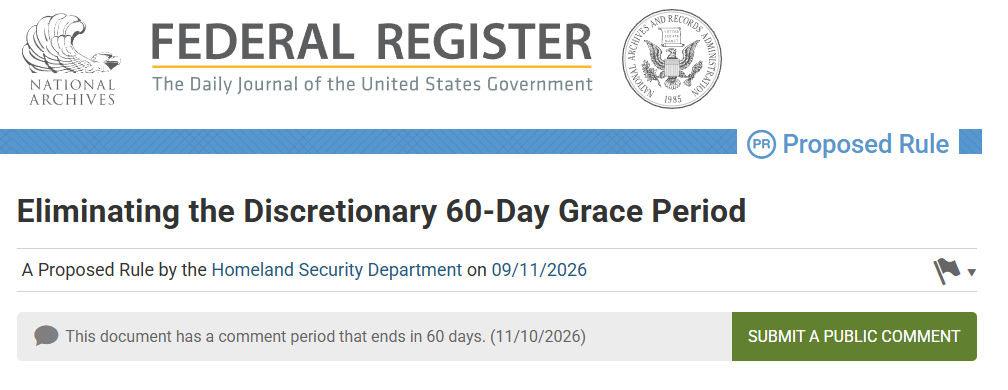
Currently, if you're working in the U.S. pursuant to a nonimmigrant status (i.e. H-1B, L-1, O-1, E, and TN) and you lose your job, you get up to 60 days to find a new sponsor, change status, or leave the U.S. without being considered "out of status". It has been rumored that the Department of Homeland Security (“DHS”) had intentions of getting rid of that grace period entirely, but until today, nothing had been published.
What's Actually Being Proposed
On September 11, 2026, DHS/USCIS published a Notice of Proposed Rulemaking to eliminate the discretionary 60-day grace period at 8 CFR 214.1(l)(2), the regulation that currently lets certain nonimmigrant workers stay in the U.S. for up to 60 days (or until their authorized validity period ends, whichever is shorter) after their job ends.
Under the proposal, that grace period, and peace of mind, disappears. A worker would be considered to have failed to maintain status the day after their qualifying employment stops, unless some other valid status already covers them. Dependents (spouses and children) lose status on the same timeline. If put in place, there will be no separate grace period for them either.
This is a proposed rule. DHS is taking public comments through November 10, 2026. Nothing has changed yet; the current 60-day grace period is still in effect while this makes its way through the rulemaking process, which can take months and often longer.
Who Is and Isn't Affected
This proposal covers eight specific nonimmigrant worker classifications: H-1B, H-1B1, L-1, O-1, E-1, E-2, E-3, and TN, plus their dependents. If you hold one of these statuses, this is squarely about you.
Here's who & what it does not impact:
F-1 and J-1 students: this proposal, in it’s current form, has nothing to do with student status. It's not connected to the Duration of Status rule change taking effect September 15, and it's not connected to the OPT unemployment-day tracking that F-1 students on OPT already have to manage.
The 10-day pre/post-validity admission period: most of the impacted visa holders already get a 10 day grace period on their I-94s (and on approval notices) when they first enter or before their status expires. This is also a different regulation and isn't part of this proposal.
H-1B Changes of Employer: the ability to start work for a new H-1B employer once a new petition is filed, before it's approved is also unaffected by this proposal, as written.
Historical Context
The 60-day grace period is less than 10 years old. It just became effecting in January 2017, as part of the high-skilled worker rule, specifically to give H-1B and other work-visa holders room to find a new job or transition status without being forced to scramble or leave the country the moment they were laid off. It was framed at the time as a stability and job-portability measure for exactly the kind of skilled workforce this proposal now targets. DHS's stated rationale for removing it is to align the regulation more closely with the underlying statute and cut down on case-by-case discretionary determinations for USCIS. However, "administrative burden" is doing a lot of work in that justification given how much is on the line for affected workers.
TLDR
The 60-day grace period is still in effect right now, and this proposal has to go through a comment period and a final rule before anything changes.
If you're an employer sponsoring workers in any of these categories, this is worth building into your contingency planning now, particularly for layoffs, restructurings, or any scenario where a worker's status might lapse before a new petition or status change is ready.
If you're a worker on one of these visas, know that the safety net you may be counting on could shrink or disappear, and it's worth talking to your employer's immigration counsel about what a job loss would actually look like under a final version of this rule.
And if you want to weigh in directly, the comment period is open through November 10, 2026, you can do that here.
This post is for general information only and is not legal advice. For guidance on your specific situation, please consult a licensed immigration attorney.
